
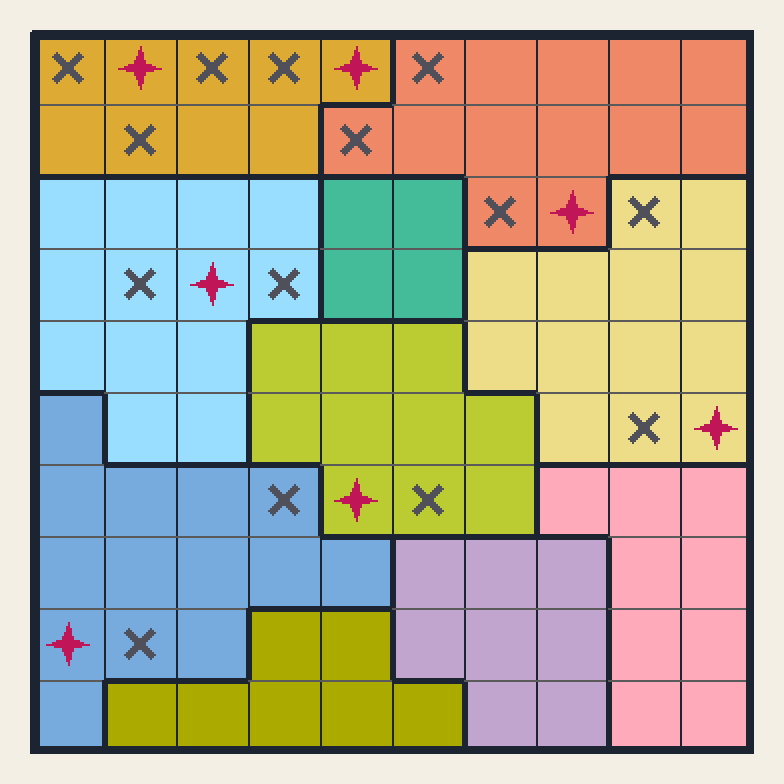
This page is a free star battle puzzle: today’s official 10×10 two-star grid, playable in the browser with no account. In a star battle, every row, every column, and every region holds exactly two stars, and no two stars may touch — not even diagonally. The layout is the same for every player, it has one unique solution, and it sits beside the easier daily region puzzle rather than replacing it.
What is a star battle puzzle
A star battle puzzle is a placement game on a partitioned grid. You are given a square, usually 10×10 in the classic two-star form, already cut into as many regions as there are rows. Your task is not to draw those regions. It is to drop a fixed number of stars — two, in the classic form — into each row, each column, and each region, while keeping every pair of stars at arm’s length.
The “battle” is between space and quota. Two stars in a ten-cell row would be easy if they could sit anywhere. They cannot. Because stars may not touch, even at a corner, two stars in the same row must have at least one empty cell between them, and that empty cell also blocks the rows above and below on the diagonal. A tight region of three cells in a straight line almost always wants the pattern “star, gap, star.” A wide, winding region gives you more room and, in exchange, more ways to go wrong if you place too early.
Regionle’s star battle puzzle is the day’s second grid. The first grid, on the home page, is a one-star daily region puzzle on an 8×8 board: a warmup that keeps your streak. This page is the two-star classic on a 10×10 board, with ten regions. Both are free, both are unique, and both follow the same adjacency rule. The two-star quota is what changes the feel. There is more to count, more interaction between neighboring regions, and usually a longer, quieter middle game.
The genre is older than this site. Puzzle editors have published two-star grids under the star battle name for many years, and the rule set is stable enough that a player who learned it on paper will recognize this board immediately. Regionle’s contribution is a fresh, solver-verified grid every day, a browser board that is comfortable on a 390-pixel phone, and a share card that talks about your time without revealing star positions.
How to play
The grid at the top of this page is today’s star battle puzzle. Tap a cell to cycle empty, cross, and star. Drag to paint crosses in a sweep. Auto-X, which is on by default, marks the eight neighbors of every star and, once a row, column, or region already holds two stars, fills the leftover cells of that unit with crosses. Undo and Clear work the same way they do on the one-star board. The timer starts on your first mark.
Because each unit wants two stars, Auto-X is a little more patient than it is on the warmup. Placing the first star in a row does not finish that row. It only carves a moat around that star and leaves you to find the second. This is where most of the deduction lives. A hint still returns a single forced cell from the server, computed from your current marks, and never the whole solution.
When twenty stars sit on the board — two in each row of a 10×10 — and every region and column agrees, and nothing touches, the grid is checked and accepted. Your result is stored in this browser. If you already finished today’s daily region puzzle, accepting this star battle also makes a full clear. If you have not, you can still play this grid first; just know that the streak is decided on the one-star page. There is no time limit other than your own patience, and a new star battle arrives with the rest of the issue at midnight, America/New_York.
Rules
A star battle puzzle on Regionle uses four rules, two of which differ from the one-star warmup only in the number two.
Place exactly two stars in every row. Place exactly two stars in every column. Place exactly two stars in every region. Regions are 4-connected colored territories; a cell belongs with its edge-neighbors of the same color, not merely with its corner-neighbors. The 10×10 daily grid has ten such regions, so the quotas line up: ten rows, ten columns, ten regions, two stars each, twenty stars in all.
No two stars may touch, including diagonally. The forbidden neighborhood is the eight cells around a star. In a two-star row that rule has a direct consequence: the pair cannot sit in adjacent cells and cannot sit on a diagonal contact if they are in neighboring rows. The minimum legal pattern along a straight three-cell region is a star at each end and an empty cell in the middle, because a star in the middle would touch both ends and leave the region short.
There are no extra symbols and no cells that ignore the moat. A finished star battle is simply a placement that meets the four rules. Each published grid has exactly one such placement, proved in advance by an exact solver. If a candidate layout had a second legal finish, it would not appear on this page.
Tips for a star battle puzzle
Hunt for size-three regions first. A three-cell region that must hold two stars, with the no-touch rule in force, is extremely constrained. If those three cells are in a straight line, the ends are stars and the middle is empty — you can often pencil that in on sight. If the three cells make a small bend, there is usually only one pair that does not touch, or only one pair that also leaves enough space in the crossing rows.
Use leftover capacity. After a few forced stars, ask how many stars each unfinished row still owes, and how many living cells it still has. A row that owes two stars and has only three living cells is a close cousin of the size-three region: the pattern is almost determined. The same count on a region that has already placed one star tells you where the second one is allowed to stand. When two regions share a narrow frontier, placing the second star in one can extinguish the last legal cell of the other — that contradiction is a gift, because it tells you the first of those placements was wrong.
Think in pairs, not in single stars. On the one-star daily region puzzle, a finished unit is done. On a star battle puzzle, the first star is a beginning. It throws a shadow (the moat) that the second star must stand outside. Sometimes it is easier to decide where a pair cannot go than where it can: a two-cell nook in the corner of a region cannot hold both stars, so at most one of those cells is a star, and often neither is, if a better pair sits elsewhere.
Resist early guesses. Uniqueness is on your side. If two placements seem equally possible, a count you have not yet made will break the tie. A careful mental trial — place a provisional star, follow Auto-X or your own crosses, and watch for a region with no remaining cell — is fair play, and Undo is there for that. The hint button is a smaller, server-side version of the same idea. Either way, do not spend a long fork on a guess when a size-three region is still sitting untouched at the edge of the board.
If you are new to the genre, play today’s daily region puzzle first. The adjacency rule is identical, the board is smaller, and the one-star quota teaches you to see a moat without also juggling a second star. Then come back here. For a slower walkthrough of the controls that both boards share, see how to play. For a deeper look at one-star reasoning, the region puzzle rules page is the better companion than this one.
FAQ
How is a star battle puzzle different from the daily region puzzle?
Both use colored regions and the same no-touch rule. The daily region puzzle on the home page is 8×8 with one star in each row, column, and region. A star battle puzzle on this page is 10×10 with two stars in each of those units. The streak is kept on the one-star grid.
Does this star battle have a unique solution?
Yes. Every published grid is proved unique by an exact solver before it is issued. You should not need to choose between two equally legal finishes.
Can I play the star battle puzzle before the warmup?
Yes. This page is independently playable. Finishing it does not by itself keep your streak; the one-star daily region puzzle does that. Finishing both is a full clear.
Why are three-cell regions so important?
A region of three cells that must hold two stars has almost no freedom under the no-touch rule. The legal pairs are few, and in a straight corridor they shrink to a single pattern: stars at both ends. Those forced stars then throw moats into the neighboring rows.
What do I share when I finish?
A spoiler-free card with the issue number, your time, whether you used a hint, and your streak if you also finished the one-star grid. The card never includes star positions or a picture of the solved board.
When is a new star battle published?
At midnight, America/New_York, together with the day’s daily region puzzle. Every player receives the same pair for that game day.