
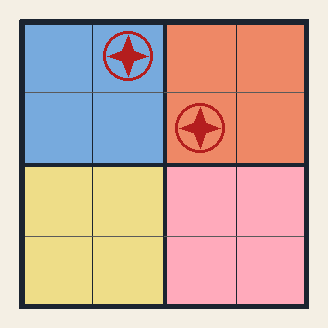
What is a region puzzle
The phrase “region puzzle” names a small, precise contract. You are looking at a square divided twice: once into rows and columns, and once into regions. A region is a connected set of cells, usually painted in its own color, and the connection is by edges rather than corners. Your marks are stars. In the one-star form, which is the form this page is about, the contract is “one star per region,” and the same “one” applies to every row and every column.
That last clause is what stops the puzzle from being a simple matching exercise. If you only had to put one star in each region, you could drop a star in any cell of each territory and be done. The rows and columns complain. A star that satisfies a region may sit in a row that already has one, or in a column that will need its star later and cannot afford this one. The no-touch rule complains too: a legal-looking pair of region-stars may be illegal because they meet at a corner.
Regionle publishes a free daily region puzzle on an 8×8 board with eight regions. That grid is the day’s warmup, and finishing it is what keeps a streak. The site also publishes a two-star star battle puzzle on a 10×10 board; that is the same family with a different quota, and it has its own page so the two intents are not competing for the same role. If you came here because you want to play, open today’s daily region puzzle and start marking. If you came here because you want to understand why a move is forced, stay and read.
The one-star form is a good teacher. With only eight stars on the board, every placement is a large fraction of the remaining work, and a single mistake is obvious once a row has two stars or a region has none. It is also a serious puzzle when the regions wind around each other. A long corridor, a two-cell nook, and a bulky six-cell territory on the same grid will pull on each other in ways that are not obvious from any one unit.
A region puzzle of this kind sits in the same family as the daily crown-placing grid that appears on a well-known professional social network. This site is not affiliated with LinkedIn or Microsoft.
How to play today’s grid
Go to the Regionle home page. The 8×8 board there is today’s region puzzle, the same grid for every player, available at no cost and without an account. Tap to cycle a cell through empty, cross, and star. Drag to paint crosses. Auto-X, on by default, fills the cells that a newly placed star has made impossible. A hint, if you want one, returns a single forced cell from the server and does not reveal the rest of the answer. The timer starts on your first mark and is only there for your own record and your share card.
This rules page does not host a second indexable copy of that board. One playable daily region puzzle is enough: it lives at the root URL, it is updated at midnight in New York, and any deep link from this guide should take you there. When you have finished the warmup, the results card will offer the day’s star battle puzzle as an optional second course.
Rules
A one-star region puzzle on Regionle has four rules.
One star in every row. One star in every column. One star in every region. Regions are 4-connected: cells that share an edge and a color are in the same region; cells that only share a corner are not, even if the colors look close. The number of regions equals the number of rows, so the three “one star” statements are talking about the same number of stars — eight on the daily 8×8.
No two stars may touch, including diagonally. Around every star, the eight neighboring cells must be empty of stars. Those cells may belong to other regions and to other rows; the moat does not care. This is the rule that surprises people who have only played puzzles where “adjacent” means “sharing a side.” On a region puzzle, a corner contact is already too close.
Those rules are complete. There is no fifth constraint hiding in the instructions, no cell that is pre-filled, and no region that needs a different number of stars on the daily one-star grid. Each published puzzle has exactly one placement that satisfies all four rules, proved by an exact solver. The board you play is only the region map; the solution stays on the server until the grid is correctly finished.
Tips for one star per region
Treat “one star per region” as a counting tool, not just a goal. For each unfinished region, list the cells that are still alive: not already crossed, not in a row or column that already has its star, and not in the moat of a placed star. If the list has one cell, that cell is a star. If the list is empty, a previous mark is wrong, and you should undo rather than invent a new rule.
Small regions first is still the right opening, but “small” means “few living cells,” not only “few cells on the map.” A six-cell region that has already lost five cells to moats and finished rows is just as forced as a two-cell region at the start. Conversely, a two-cell region that sits entirely in an open row is not yet decided; you need a reason to prefer one cell over the other, and that reason will usually come from a column or from a diagonal threat to a neighboring region.
Draw, or let Auto-X draw, the moat immediately. The most common self-inflicted stall is a star with an unmarked diagonal, followed by a second star that “almost fits” in the neighboring region. Marking the eight neighbors as empty turns that stall into a visible shortage: the second region loses a cell, and you either have a forced remainder or a contradiction you can still undo.
When two regions lean on the same two rows, think about a matching. Two regions and two rows, each wanting one star, often means the stars are a permutation: one region takes the first row, the other takes the second, or the reverse. The no-touch rule will often forbid one of those two permutations because the candidate cells sit on a diagonal. That single forbidden pairing is a complete reason to place both stars.
Read a little, then play. Advice is cheaper than a spoiled grid, and this page will still be here after you finish today’s region puzzle. If you want the two-star version of the same ideas — leftover capacity, size-three corridors, pairs instead of single stars — the star battle puzzle page is written for that quota. If you want the buttons and the streak rules in one short checklist, use how to play.
FAQ
Where do I play today’s region puzzle?
On the Regionle home page. That 8×8 one-star grid is the free daily region puzzle. This page explains the rules and tips; it does not duplicate the playable board.
What does “one star per region” mean in practice?
Each colored territory gets exactly one star, no more and no fewer, and that star also counts as the single star for its row and its column. Combined with the no-touch rule, this is enough to force a unique finish on every published grid.
Why can’t stars touch on a diagonal?
The adjacency rule uses the eight-cell neighborhood of a star, the same reach as a king in chess. A corner contact is a touch, so it is illegal. This is part of the standard rule set for the genre, not a Regionle extra.
How is a region shaped?
A region is a 4-connected set of cells: you can walk from any cell of the region to any other by stepping through edges, not through corners. Shapes vary from compact blocks to long corridors, and the variety is what makes one day’s region puzzle feel different from the last.
Is the solution sent to my browser when the page loads?
No. The page receives the region layout only. The server checks a finished board when you submit it, and a hint returns one forced cell. The full solution is not bundled with the page.
Does this page have its own daily grid?
No. There is one daily region puzzle, and it is playable at the root URL. Keeping a second copy here would split the game across two indexable addresses without a new purpose.